Color and Form
ExhibitionsA work of art is the result of the author’s struggle with their thoughts and with matter itself (for example, with canvas, paint, etc.). Struggle exists even when the viewer is overwhelmed by the initial impression that the work emerged into the world after only a single, light, and elegant movement of the hand. The aspect of struggle reveals that painting is not merely a gift to the viewer; it also serves as a means of self-discovery for the creator and as a mark of their existence.
Abstract art is not merely a formal game. In a generalized way, it represents the author’s sensations and liberates the viewer from the obligation to experience the world through clearly identifiable images of reality and color. Drawing on Gilles Deleuze, one may say that in painting, “thoughts erupting through a meditation of heightened consciousness reveal the essential desires of the meditating person.” Therefore, I am less concerned with the dictatorship of realistic imagery and more with the intuitive perception of an ever-changing reality. This is precisely why painting differs from science: science understands nature through measurability, while art relies on intuition and emotions that resist measurement. Art becomes “a mediator of the unspeakable.”
From intuitive creation emerge new provocations and tensions surrounding reflections on the world. The artwork transmits the creator’s tensions to the viewer, who, often immersed in the routines of everyday life, tends to perceive reality as something elementary and unquestionable. Yet, according to Maurice Merleau-Ponty, a work of art provides intuitive access to the objects and systems of the world, exposing the very vitality of reality like the nerve of an aching tooth. This is echoed in painter Jackson Pollock’s idea that abstract painting concerns itself with mechanical reality — how things are made, what may be discovered by dismantling reality, or even by mercilessly breaking it apart. Thus, often without our noticing or preparing for it, painting revises reality by posing fundamental questions about it.
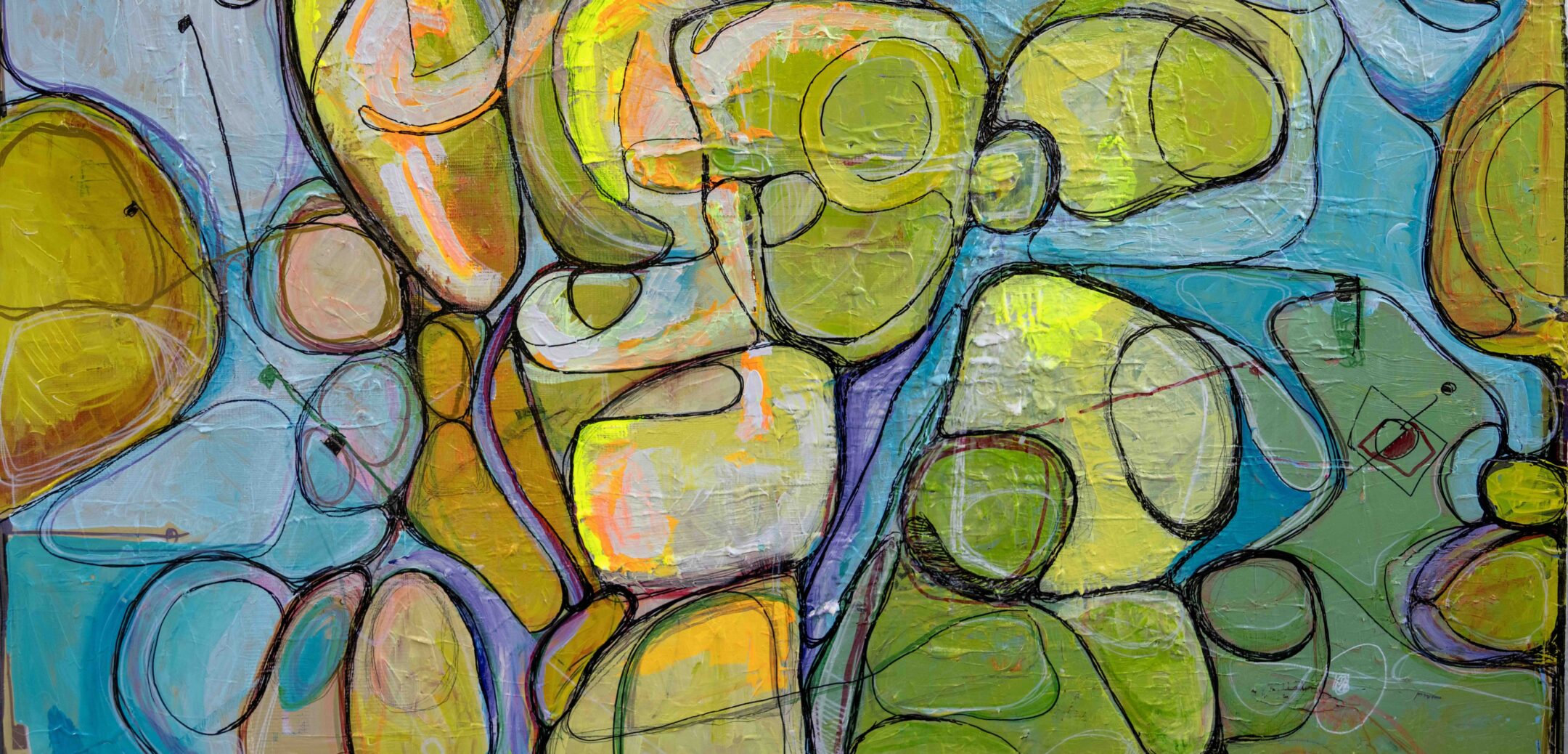
Freedom and chance accompany abstract painting. According to Herbert Read, these two components expand the boundaries of the creator’s imagination and compel the viewer’s understanding of a finite and fixed horizon of visibility to fracture. In painting, freedom and chance are connected to the dynamics of composition and unusual color combinations, where the flickering of forms — like a sign of movement — not only embodies the instability of time but also opens new horizons for the perception and interpretation of the work, horizons that do not necessarily coincide with the artist’s original intention. Perhaps this is why I value abstract painting more than figurative representation of the world. Here, the leading role belongs to the brushstroke and color rather than to the form and construction of the depicted object or subject, or to a familiar and easily predictable narrative.
It may seem that on my canvases color is applied with an awkward and unruly brush. Since every trace of the brush points in a different direction and creates the impression of the brush’s own individual life, the entire painting appears like a disobedient (anti-)system. Here, disobedience opens changing landscapes through which the viewer may wander, constantly altering the trajectory of thought and the angle of vision. Painting becomes an open question: to what extent can the viewer free their imagination, and how far can that imagination travel across the endless distances formed by the painting?
The unruly brush, the shifting and heterogeneous composition — these are the hallmarks of my creative style, formed not only from the desire to experiment and to speak differently about reality, but also from the search for a unique artistic language. While painting, I create my own system of written signs, refine it, and attempt to uncover a primordial script, what Jacques Derrida called arche-writing. All this resembles the creator’s utopian dream, an unattainable ideal — to penetrate authentic artistic language, to fully comprehend it, and to speak through a perfect artwork. Every image (like writing itself) indirectly and/or fragmentarily points toward some origin of the image.
In the creation of experimental media, I shape my artistic language by applying a method of technological exploration. By combining various digital tools, I unexpectedly discover compelling visual solutions. Such a creative strategy may be described as hybridization, which Wolfgang Welsch explains as a bewildering combination of expression and technique. Thus, the pursuit of unexpectedness determines the overall authorial landscape of interdisciplinary media.
In the creation of a cycle of paintings, as in the arrangement of an exhibition, everything happens organically, much like an orchestra performing a musical composition: at one moment the sound of string instruments becomes prominent, later the keyboards emerge, while in the background the rhythm of percussion intensifies and subsides. As in music, so too in painting, I am interested both in the resonance of the individual work and in the sound of the entire collection. The system of painting represents change, in which some accents intensify while others provide depth or soften their piercing resonance. Through rhythm, the paintings declare a moving, rather than static, world; they create the possibility of experiencing drama rather than peaceful slumber.