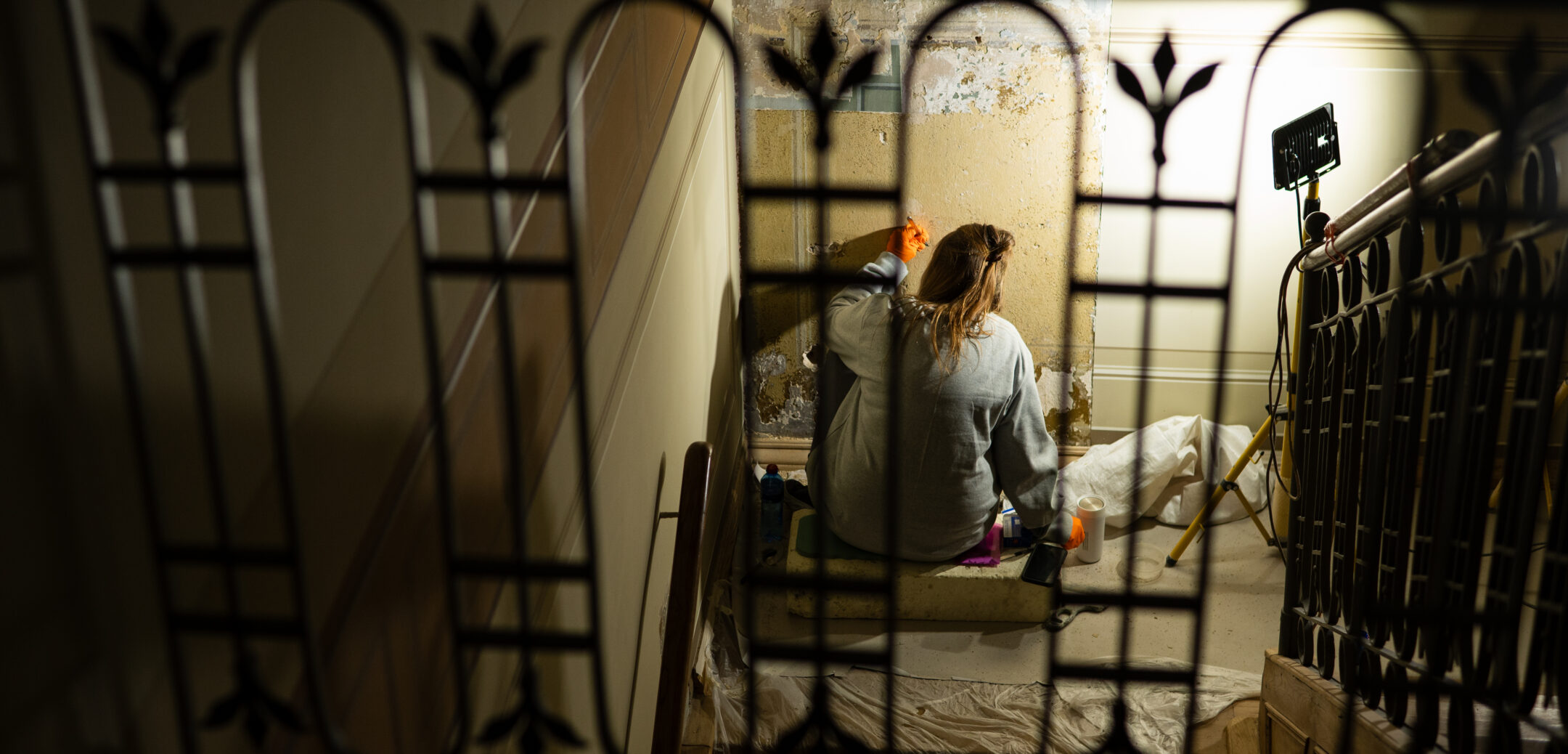
2026 – Another Year in the Restoration of Trakų Vokė Manor
In 2026, restoration and preservation work continues at the Trakų Vokė Manor House. This year, our primary focus is on the formal spaces of the first floor, gradually restoring their historical appearance, splendor, and authentic architectural details.
The White Hall (Ballroom)
We began the year with one of the most complex tasks: raising the ceiling structure in the central White Hall to restore the room’s original height. This new structure has been prepared for one of the most anticipated phases of the project—the restoration of the historical ceiling fresco. From below, it has been boarded over, covered with reed mats, and plastered, creating a traditional base for the painting.
Work on restoring the fresco commenced in late September. We expect that by the end of the year, the intended final appearance will be clearly visible, even if the full restoration process is not yet entirely complete.
Wall sconces have already been installed in the hall; their design was selected based on historical photographs of the manor. They help restore the sense of grandeur and formality that once defined this space.
Once the ceiling fresco is restored, another striking feature will be added to the center of the hall: an ornate crystal chandelier, brought from Italy. Its design was also chosen based on historical photographs and will help recreate the former splendor of the Ballroom. The Historic Dining Room
Restoration of the plaster ceiling in the historic dining room was completed this year. During the conservation work on the walls and floors, new, valuable interior elements were discovered, including fragments of painted wall-panel decoration.
Future plans include polychrome painting of the walls—based on the results of polychrome analysis—and the restoration of the historic parquet flooring. Other historic interior details will also be reconstructed. The restoration of the fireplace decoration is planned for a later stage, contingent upon securing the necessary funding.
The Count’s Study
In the Count’s study, the restoration of the highly ornate plaster-decorated ceiling has already been completed. This is one of the spaces slated for full restoration by 2026.
The walls will undergo polychrome painting, the parquet flooring will be refurbished, and the historic door openings and doors will be reconstructed. *Supraportes* (decorative elements above the doors) will be recreated, along with historic decorative moldings on the walls.
Once these works are finished, the Count’s study will become one of the first rooms in the palace where visitors can experience a fully reconstructed historic interior.
The Countess’s Bedroom
In the Countess’s bedroom, the plaster-decorated ceiling has been refurbished, and its ornamentation—which lends the space an exceptional level of opulence—has been restored.
The door leading to the corridor—historically associated with the palace’s service areas—has also been reconstructed. By the end of the year, final architectural investigations are planned for this space; these will allow for more precise decisions regarding the subsequent steps in the restoration of the interior.
Who is funding the restoration of the manor house?
The restoration of the Trakų Vokė Manor house is a consistent, long-term process that requires the mobilization of various funding sources. Restoration and preservation works for 2026 are financed through the State Heritage Management Program, the Vilnius City Municipality, and funds generated by the public institution “Trakų Vokės dvaro sodyba” (Trakų Vokė Manor Homestead).
The funding provided by the Vilnius City Municipality accounts for a significant portion of the work, enabling the restoration to proceed steadily, in distinct stages. State support is significant not only in financial terms—it also underscores the importance of this cultural heritage site and reflects the shared responsibility of both the state and the city for its preservation.
The institution itself also contributes to the restoration of the manor house by allocating a portion of the funds generated through its own activities toward the restoration efforts. Consequently, every visit to the manor, guided tour, or event held there contributes to the ongoing restoration of the manor house. Restoration – More Than Just Renovation
In restoring the Trakų Vokė Manor Palace, our goal is not to create a “new-old interior.” Instead, we base our decisions as much as possible on what the building itself reveals—through surviving details, fragments uncovered during the restoration process, polychrome and architectural analyses, and historical photographs.
Consequently, the restoration process sometimes takes longer than one might wish. New discoveries made during the work often necessitate further research, and occasionally, a re-evaluation of previous decisions. Yet, it is precisely this approach that allows us to reveal the authentic history of the palace with the greatest possible accuracy.
By 2026, we are able to see not only individual restored elements but also a increasingly clear picture of the historical interiors of the Trakų Vokė Palace.